Decentralized Finance (DeFi): The Blockchain Revolution in Finance
This is not financial advice. Cryptocurrency is unregulated in the UK; profits may be subject to tax; and the value of any investment could fall.

Decentralized Finance, better known as DeFi, is a complex topic, but its potential is enormous. Essentially, it’s the use of blockchain to decentralize traditional financial systems. It’s about creating an open, accessible, and equitable financial future for everyone.
But what’s the benefit? Well, DeFi comes with a host of advantages. It’s transparent, it’s open to everyone, and it operates around the clock. It’s a game-changer for those historically left out of the financial system.
However, as with any new frontier, there are risks. This sector has its fair share of challenges and potential pitfalls. Everything from regulatory issues to technical glitches can pose problems.
One of the most interesting aspects is how DeFi stands up against traditional finance. It’s a hot topic, and we’re here to dive into it.
This piece aims to guide you through the DeFi versus traditional finance debate and serves as a stepping stone to understanding the future of DeFi.
Understanding the Concept of Decentralized Finance (DeFi)
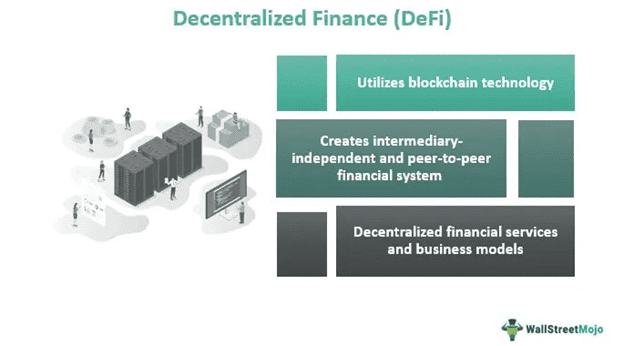
DeFi signifies a major shift. It moves us away from the norm of centralized banking systems. Instead, it introduces a model that enables financial transactions through a decentralized network. It’s like taking a journey from a controlled environment into one that offers more freedom and control.
So, how does DeFi work? The magic lies in its use of blockchain technology. This technology is a game-changer as it eliminates the need for intermediaries. This means that users have complete control over their financial decisions. It’s like becoming your own bank, free from the usual constraints.
Apart from giving users more control, DeFi also has other benefits. It enhances transaction speed and cuts down costs. Plus, it offers greater transparency and accessibility, making financial systems more user-friendly.
The Extensive Benefits of DeFi
DeFi’s innovative features and applications are changing the game, and here’s why.
One of the main selling points of DeFi is its democratization of financial services. Quite simply, if you have an internet connection, you can use it. It’s a 24/7 operation, offering faster and cheaper transactions. All this is made possible by blockchain technology.
But it’s not just about speed and cost. DeFi also gets rid of the middleman. This means direct peer-to-peer interactions, paving the way for greater financial inclusivity. This is particularly significant for those who don’t have access to traditional banking.
DeFi is also an open book. Its open-source nature promotes transparency, fostering trust among its users. This is a refreshing change, especially considering the aftermath of the 2008-2009 financial crisis.
Another huge advantage is the use of smart contracts in DeFi. These allow for automation and reduce the chance of human error.
Despite facing some challenges, DeFi’s benefits, including its potential integration with your own proof-of-stake blockchain, could pave the way for a more open, efficient, and inclusive financial system.
In simpler terms, DeFi is breaking down barriers and making finance more accessible for everyone.

DeFi vs. CeFi (Centralized Finance)
Let’s dive in and take a closer look at the two prominent types of finance: Decentralized Finance (DeFi) and Centralized Finance (CeFi). Each has its own unique characteristics, strengths, and weaknesses, which we will explore in this table.
| Aspect | Decentralized Finance (DeFi) | Centralized Finance (CeFi) |
| Operational Principles | Built on blockchain technology with peer-to-peer transactions | Relies on centralized institutions and intermediaries |
| Transparency | High level of transparency due to blockchain ledger | May lack transparency due to centralized control |
| Accessibility | Offers greater accessibility to anyone with an internet connection | Accessible but may have restrictions and requirements |
| Control | Users have complete control over their assets and decisions | Control is partially relinquished to centralized entities |
| Regulatory Oversight | Regulatory landscape is uncertain, varying by region | Strong regulatory oversight for consumer protection |
| Efficiency | Transaction efficiency can vary, often reliant on blockchain speed | Transactions are typically swift and reliable |
| Security | Susceptible to hacking and security breaches | Generally more secure, but still vulnerable to cyber threats |
| Critiques | Faces challenges related to security and regulation | Criticized for lack of transparency and systemic risk |
| Longevity | A relatively new concept in finance | An established system that has endured over time |
Key Components in the DeFi Ecosystem
The DeFi, or Decentralized Finance, ecosystem is a complex, yet fascinating, world. At its core, it’s powered by several key components. These include elements such as smart contracts, decentralized exchanges, and digital wallets.
Now, let’s break down these components for a better understanding.
- Smart contracts. These are self-executing contracts. The terms of the contract are written directly into code. This unique feature makes them a fundamental building block for creating applications in the DeFi space.
- Decentralized exchanges, also known as DEXs. These are platforms that make peer-to-peer transactions possible, without any need for an intermediary. The big advantage here is that DEXs operate on blockchain technology. This means every transaction is transparent and secure, which is a big plus for users.
- Digital wallets. These are like your personal safe for storing and managing your digital assets. They are a crucial component of the DeFi ecosystem as they provide the space for users to hold their digital wealth.
Beyond these three core components, there are other important elements like liquidity pools and yield farming platforms. They provide opportunities for users to earn returns on their holdings.
In essence, they are platforms where users can put their assets to work and earn revenue – a concept that’s gaining popularity in the DeFi world.
Potential Risks and Challenges in DeFi
DeFi is a promising field with great potential, but it comes with its own set of hurdles.
The first challenge lies in the technology that underpins it – smart contracts. These contracts can be subject to bugs and other exploitations. If these potential issues aren’t identified during a thorough audit, the consequences could be significant, leading to substantial financial losses.
The second challenge facing DeFi is the uncertain regulatory landscape. As we speak, governments around the globe are trying to understand and regulate this new space. Compliance, then, becomes a moving target. As rules and regulations constantly shift, it could have an impact on the growth of DeFi.
The complexity of DeFi is another factor that could hinder its mainstream acceptance. Its technical nature could intimidate the average person. For DeFi to truly take off, it needs to be user-friendly and accessible to all.
Finally, let’s talk about the ethical and legal issues. The blockchain technology that DeFi is built on operates on a pseudonymous basis. This means that it could unintentionally aid in illicit activities. This raises serious ethical and legal concerns that need to be addressed.
Conclusion
The advantages of DeFi could be enormous, with the potential to revolutionize the financial landscape. Imagine a world where finance is more accessible and equitable to all, not just a privileged few.
As DeFi keeps evolving, it’s crucial to understand and navigate this new financial ecosystem. The future of finance could very well be defined by it. So, let’s keep an eye on this space, as understanding DeFi could be the key to unlocking a new era in finance.